
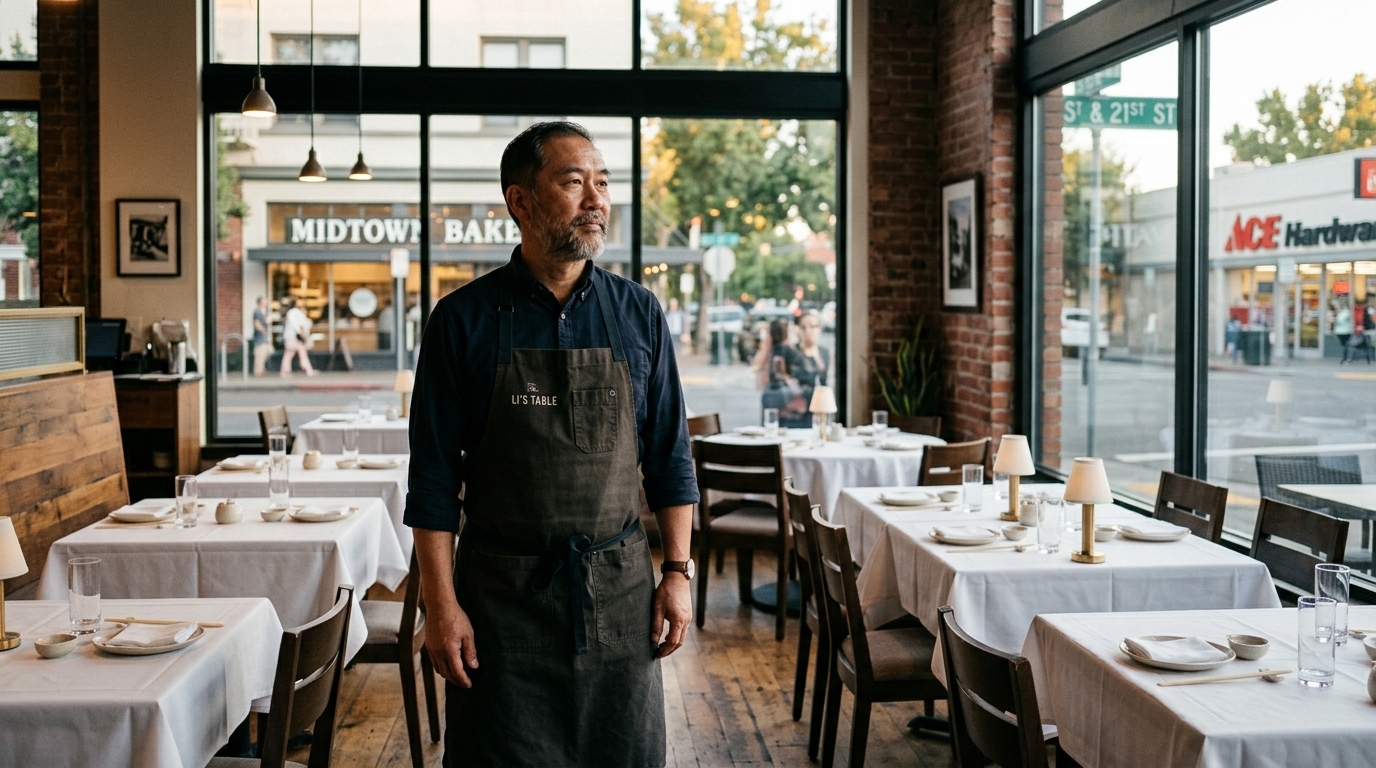
- SBA 7(a) loan funded
- $325,000
- Time from application to close
- 62 days
- Dining room capacity increase
- +50% (48 → 72 seats)
- Annual revenue growth (12 months)
- $1.1M → $1.45M
- Kitchen throughput increase
- +35%
- Monthly loan payment
- $3,380
The Situation: Twelve Years In, and Nowhere Left to Grow
James Chen co-founded Pacific Table — a contemporary Chinese-American restaurant in Sacramento's midtown — with his wife in 2011. By 2023, the business had built something most operators spend a decade chasing: a loyal lunch crowd, consistent dinner traffic, and a catering line that filled weekends.
The problem was physical. An undersized kitchen limited what the line could produce during peak service. The dining room seated 48 guests — and on Friday and Saturday nights, James was turning away parties of six and eight at the door. He estimated he was leaving $300,000 or more in annual revenue on the table, literally and figuratively.
He approached two regional banks about a conventional loan. Both declined to lend the full amount he needed, citing insufficient collateral. The restaurant owned its equipment but leased its space — a common situation for established restaurant operators who haven't yet built real-property equity.
His accountant pointed him toward SBA 7(a) financing. The SBA's flagship loan program is partially guaranteed by the federal government, which allows lenders to extend credit to businesses that can't satisfy conventional collateral requirements. James had never considered it before. Within six months, it had changed his business.
The Approach: Choosing the Right Lender First
Not all SBA lenders work at the same speed. James's accountant steered him toward a Sacramento bank enrolled in the SBA's Preferred Lender Program (PLP) — a designation the SBA grants to high-volume lenders that have demonstrated sound credit judgment. PLP banks can approve 7(a) loans entirely in-house, without routing the application back to the SBA for a separate credit review. That in-house authority is what separates a 60-day close from a 90-day-or-longer one.
James assembled his application package:
- Three years of business tax returns showing $1.1M in annual revenue
- A business plan and financial projections — revenue assumptions tied to the expanded seating count
- A signed contractor bid covering the kitchen build-out and dining room renovation
- Personal financial statements and tax returns for himself and his wife
The lender ordered a credit report: James carried a 720 FICO, and the business showed no derogatory history. After underwriting, the bank approved a $325,000 SBA 7(a) loan at a variable rate of prime + 2.75% — approximately 10.25% at the time of closing, within the SBA's allowed spread for loans of this size. The loan was amortized over 10 years, the standard maximum for non-real-estate SBA 7(a) use of funds.
From the day he submitted his application to the day he received his first draw: 62 days.
Want to know exactly what lenders look for? See our guide on how to qualify for an SBA loan before you apply.
- Product
- SBA 7(a) Loan
- Amount
- $325,000
- Term
- 10 years
- Time to fund
- 62 days
- Use of funds
- Kitchen expansion (second prep line, commercial hood), dining room renovation, working capital reserve
The Result: More Covers, More Revenue, Same Team
Pacific Table closed for three weeks during the build-out. When it reopened, the kitchen had a second prep line and an upgraded commercial hood system. The dining room had been reconfigured to seat 72 guests — a 50% increase in covers without expanding the physical footprint.
The operational impact showed up quickly. A second prep line allowed the kitchen to run two simultaneous ticket queues, reducing bottlenecks during the 6–8 p.m. peak. Table turns improved. The catering operation, which had shared kitchen time with dinner prep, now had its own window.
Within 12 months of reopening, Pacific Table's annual revenue grew from $1.1 million to approximately $1.45 million — roughly 32% growth on the same labor base. Kitchen throughput increased by an estimated 35%.
James's monthly SBA loan payment is $3,380. At the restaurant's current revenue and margin, it represents a manageable fixed cost that the expansion itself more than covers.
"Once we mapped out the projections — new seat count, faster table turns, the catering window we'd never had before — it was obvious the loan would pay for itself inside the first year," James said. "The only regret is not doing it sooner."
I'd been putting off the expansion for three years because I didn't know how to finance it without draining our reserves. The SBA loan let us do the whole project and still have a cushion. Two years later, we're serving 50 percent more guests every night.
$1.1M → $1.45M
Annual revenue growth (12 months post-expansion)
+50%
Dining room capacity increase
TIP
**Key takeaways for restaurant owners considering SBA financing:** 1. **Choose a Preferred Lender Program (PLP) bank.** PLP designation means in-house approval authority — and weeks off your timeline. 2. **Have three years of clean tax returns before you apply.** Consistent, documented revenue is the single strongest signal for SBA underwriters. 3. **SBA 7(a) loans allow up to $5M and up to 10 years for equipment and working capital.** Longer terms mean lower monthly payments and better cash flow for the business. 4. **A 700+ FICO score and documented revenue are your strongest assets.** If you're below 700, spend 6–12 months improving your score before applying — our [SBA loan qualification guide](/blog/how-to-qualify-for-sba-loan) walks through exactly what to address. 5. **Get a signed contractor bid before you apply.** Lenders want to see that the project scope and cost are real and documented.
If your restaurant is ready to expand but conventional financing fell short on collateral, SBA 7(a) financing may be the bridge. FundLocal works with PLP-designated lenders across California and can help you understand what your application needs before you submit it.
Get your rate